

SMSF lending
How can an SMSF borrow money to buy real property?
Can an SMSF borrow to buy property? Only through a limited recourse borrowing arrangement, and since 10 August 2026 new LRBAs can only buy business real property. Here’s how the rules work.

Updated October 2026 to reflect current law.
Can an SMSF borrow to buy property? Yes, but only through a limited recourse borrowing arrangement (LRBA), and the rules tightened on 10 August 2026.
Since that date, a new LRBA can only be used to buy real property if it’s business real property, such as commercial premises used wholly and exclusively in a business. In general, a new LRBA can no longer be used to buy a residential investment property.
Key takeaways
- An SMSF can generally only borrow under an LRBA that meets every condition in section 67A of the SIS Act.
- New LRBAs for real property: business real property only (from 10 August 2026).
- Grandfathered: existing arrangements in place before 10 August 2026 are generally preserved, as are purchases under contracts entered into before that date. Get advice before changing or refinancing an existing LRBA.
- Borrowed money can pay for the asset and related costs, and for repairs, but not improvements.
This article covers LRBAs entered into on or after 7 July 2010, when section 67A started. Different rules may apply to older arrangements.
On this page
Can an SMSF still borrow to buy residential property?
Generally, not under a new LRBA. Schedule 5 of the Treasury Laws Amendment (Tax Reform No. 1) Act 2026 added paragraph 67A(2)(c) to the SIS Act. From 10 August 2026, real property can only be bought under a new LRBA if it is business real property within the meaning of section 66.
Business real property means real property used wholly and exclusively in one or more businesses. A house or unit rented to tenants generally won’t meet this test.
| Situation | Can the SMSF use an LRBA? |
|---|---|
| Buying a residential rental property, with a contract entered into on or after 10 August 2026 | Generally no. |
| Buying commercial premises used wholly and exclusively in a business | Yes, if every section 67A condition is met. |
| Contract to buy entered into before 10 August 2026, settling later | Yes, the change doesn’t apply (grandfathered). |
| Changing or refinancing an LRBA entered into before 10 August 2026 | Existing arrangements are generally preserved. Get advice first. |
| Buying an asset that isn’t real property (for example, some shares or units) | Not affected by the new paragraph, but all other conditions still apply. |
An SMSF can still buy residential property without borrowing, subject to the usual rules such as the sole purpose test and the limits on buying assets from related parties. The ATO has published guidance on the changes to limited recourse borrowing arrangements.
How does an LRBA work?
Apart from very limited exceptions, an SMSF can only borrow under an LRBA. For a borrowing to qualify, all of these conditions must be met:
- The borrowed money is applied to buy a single acquirable asset (and allowed costs).
- The asset is one the SMSF is allowed to acquire. It can’t be money and, for real property bought under a new LRBA, it must be business real property.
- The asset is held on trust so the SMSF has the beneficial interest.
- The SMSF has a right to acquire legal ownership by making one or more payments.
- The rights of the lender, or anyone else (for example, a guarantor seeking to be repaid by the fund), against the SMSF are limited to the asset.
- The asset isn’t subject to any other charge, mortgage or encumbrance, apart from those allowed under the arrangement.
Getting this wrong is serious. Borrowing outside these rules breaches section 67 of the SIS Act, which is a civil penalty provision. It can also put the fund’s complying status at risk.
If a fund becomes non-complying, it loses the concessional 15% tax rate on its income. Broadly, the value of its assets (less certain contributions) can also be taxed at the highest marginal rate, currently 45%.
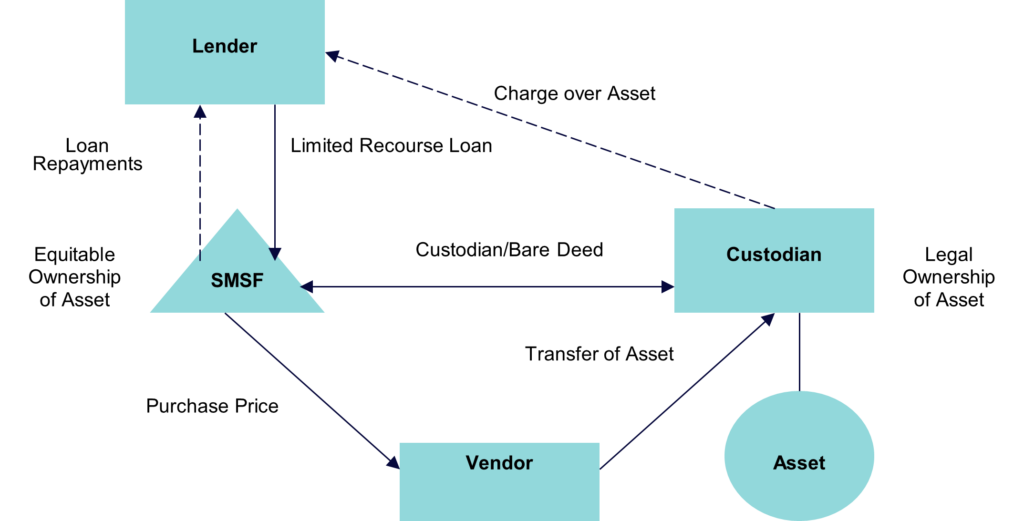
The diagram shows how a typical LRBA is set up.
The SMSF borrows from the lender on a limited recourse basis. The asset is bought and held on trust by a separate holding trustee (also called a bare or custodian trustee) for the SMSF while the loan is repaid.
The lender usually takes security over the asset. For real property, this is normally a registered mortgage. Once the loan is repaid, the SMSF can take legal title.
The single acquirable asset rule
An LRBA must be for a single acquirable asset. That can be one asset, or a collection of identical assets with the same market value that are treated as one.
The ATO ruling SMSFR 2012/1 explains how the rule works:
- What counts as a single asset: a single object of property, or a collection of objects that can’t be separated physically or legally.
- Land titles: one title of land with a building on it is usually a single acquirable asset. Several titles are generally not, unless something like a single building spans them, or the law requires them to be dealt with together.
Since 10 August 2026, if the asset is real property (including a collection of titles treated as one asset), it must also be business real property for a new LRBA.
What else can the borrowing be used for?
As well as the purchase price, borrowed money can pay expenses connected with the purchase and the loan. Examples include conveyancing fees, stamp duty, brokerage and loan establishment costs.
Borrowed money can also be used to maintain or repair the asset, but not to improve it. SMSFR 2012/1 explains the difference:
| Type of work | Examples | Can borrowed money be used? |
|---|---|---|
| Repairs | Fixing a leaking roof, replacing broken windows, repairing damaged fixtures | Yes |
| Maintenance | Painting, cleaning, servicing equipment to prevent deterioration | Yes |
| Improvements | Adding a room, or upgrading fixtures to a higher standard | No |
The line between a repair and an improvement isn’t always clear. Keep good records, and get advice before major works.
Personal guarantees for SMSF loans
Because an LRBA is limited recourse, lenders usually ask the fund’s members (or the directors of a corporate trustee) to give a personal guarantee. Section 67A limits any right the guarantor has to be repaid by the SMSF to rights relating to the asset. But your liability to the lender under the guarantee is generally not limited in the same way.
If you’ve been asked to guarantee an SMSF loan, get advice first. See our guarantor independent legal advice service.
SMSF borrowing FAQs
Can my SMSF refinance its existing residential property loan?
Existing arrangements in place before 10 August 2026 are generally preserved. If you want to change or refinance an existing LRBA, get advice first.
We signed a contract before 10 August 2026. Can we still borrow?
Generally yes. The new paragraph doesn’t apply where the asset is acquired under an arrangement entered into before 10 August 2026, even if settlement happens later.
Can an SMSF borrow to buy its members’ business premises?
It may be able to, if the premises are business real property and every LRBA condition is met. Buying from a related party, and leasing back to one, must be at market value and on proper terms.
Can borrowed money be used to build or renovate?
Not to improve the asset. Borrowed money can only be used for repairs and maintenance. Works that turn the asset into a different asset can also cause problems under the LRBA rules, so get advice first.
Do you need help?
If you’d like help with an SMSF borrowing, our SMSF set-up and advisory team can review your trust deeds and structure. Lenders can find out more about our SMSF lending and advisory services, and our notice on SMSF lenders and the SIS Act explains what lenders need to check.
Alternatively, you can give us a call, send us a message or book a call with us by clicking the buttons below.
Need advice?
Talk to our SMSF lending team
SMSF Lending & Advisory
Our team can review your SMSF loan structure and documents and help you stay compliant. Learn more about our SMSF lending and advisory service.
This article is general information only and is not legal advice. It reflects Australian law at the date of publication. Please contact us for advice about your circumstances.
Related guides
Table of Contents
Posted in SMSF